
Brain-SET Environments Formula® for Learning Environment Design
A Calm Brain Is a Thinking Brain
The Brain-SET Environments Formula® is a research-informed pedagogy created by Dr Kathryn Murray after more than 40 years in education.
It connects brain development, teaching practice and purposeful learning environment design to help educators create calm, joyful, curious and creative environments for babies, children and beyond.
What is Brain-SET?
The Brain-SET Environments Formula® is a research-informed pedagogy created by Dr Kathryn Murray that connects brain development, teaching practice and learning environment design.
Brain-SET helps educators think intentionally about how safety, emotional connection, movement, sensory experiences, relationships, curiosity, creativity and opportunities for thinking are supported through the environment.
It began through Kathryn’s work in early childhood education and has since been adapted for classrooms, education teams, organisations and other environments where people learn, work and connect.
Brain-SET is not simply about where furniture goes. It is a way of thinking about how environments, relationships and teaching practices work together to support learning.


How Does Brain-SET Change Learning Environments?
Teaching Practice
Brain-SET connects knowledge of brain development with teaching practice, relationships, play, engagement and opportunities for thinking.
The Learning Environment
Brain-SET helps educators consider how physical spaces, sensory experiences, movement, relationships and resources can support safety, regulation, curiosity, independence and learning.
Professional Practice
Through professional learning, training, coaching and mentoring, Brain-SET helps educators and leaders turn research and reflection into practical changes that can be observed, evaluated and refined.
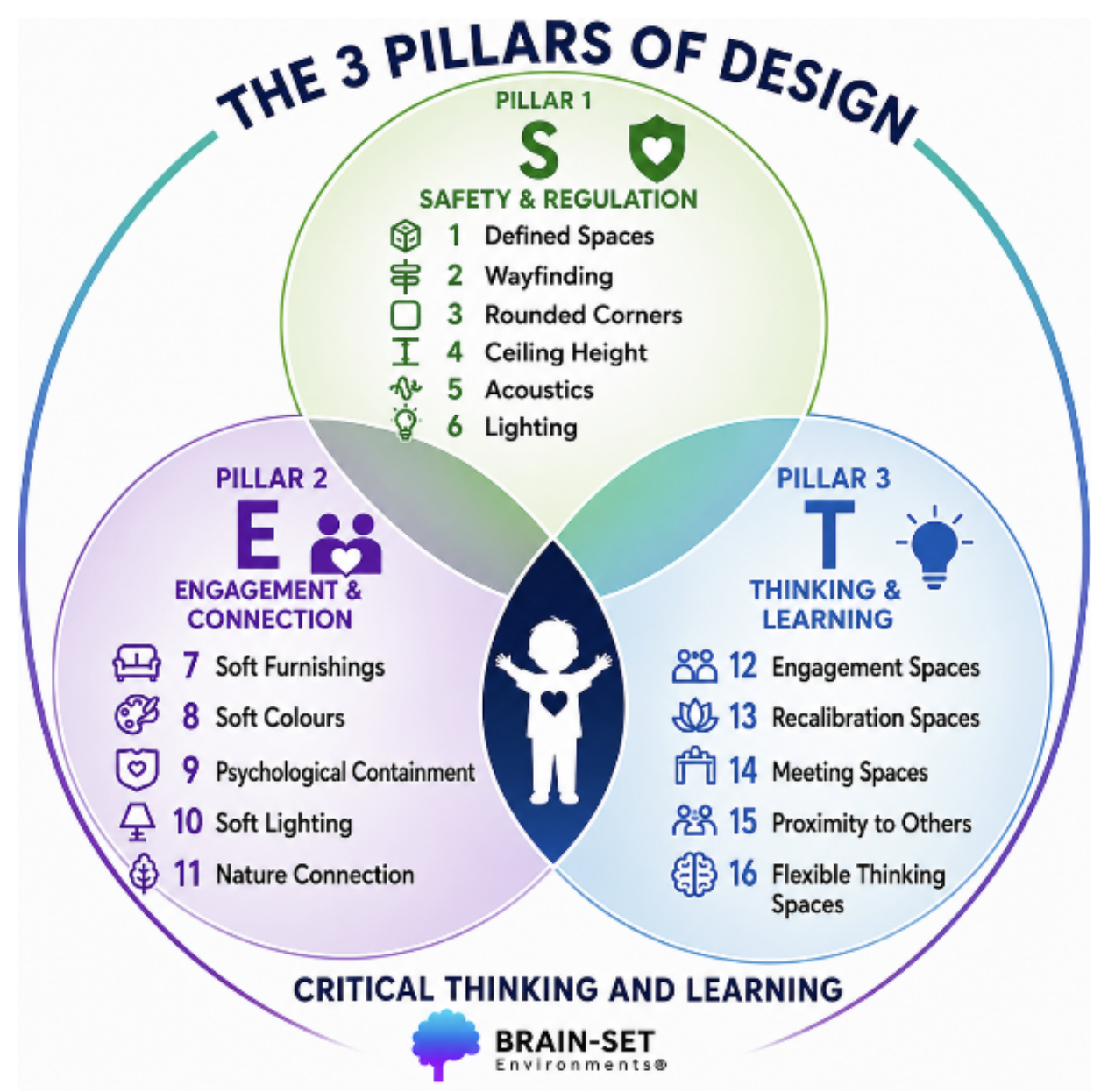
The Brain-SET Framework: 3 Pillars & 16 Design Elements
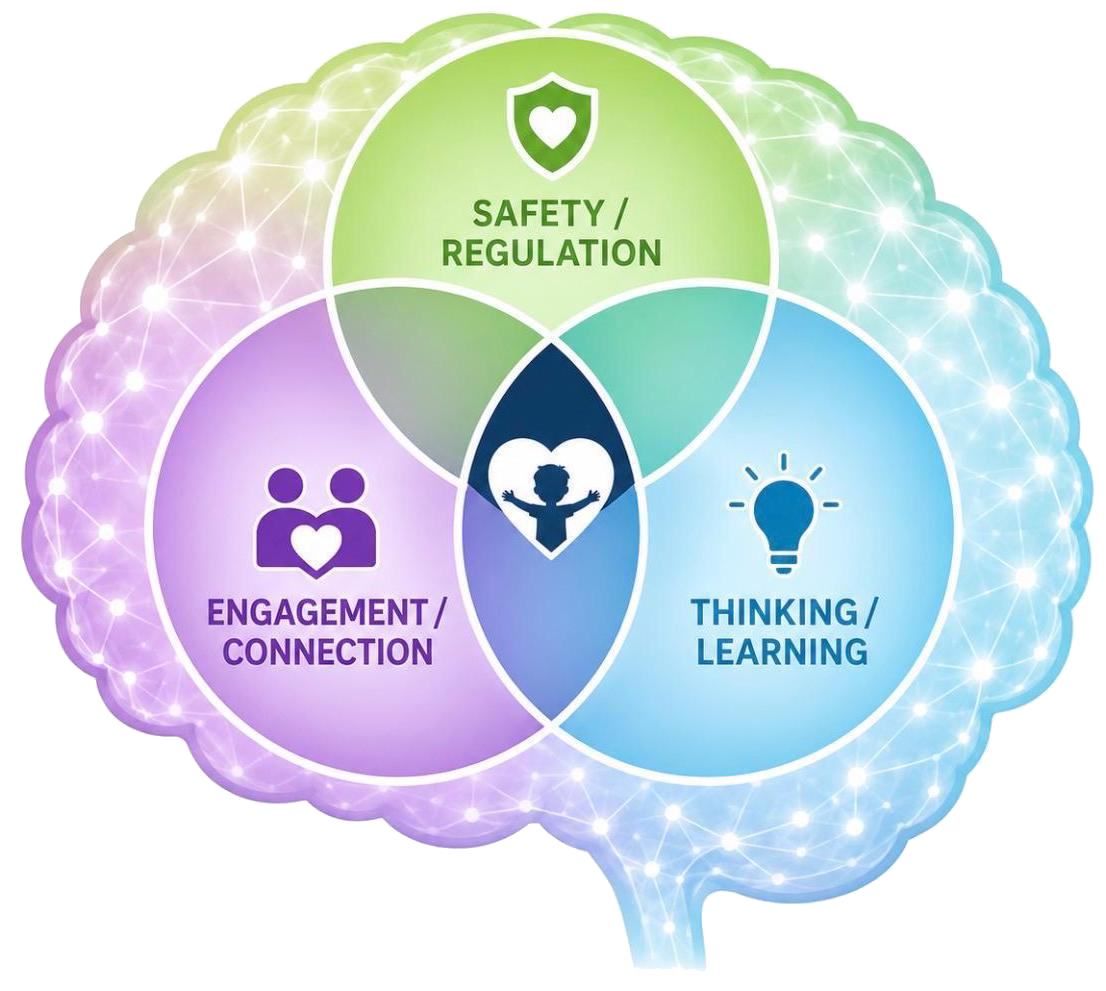
The Brain-SET Environments Formula® is organised around three interconnected pillars that help educators consider how learning environments can support the developing brain.
The approach brings together three interconnected pillars:
Safety & Regulation
Creating environments that support safety, regulation and a sense of security through purposeful design.
Engagement & Connection
Creating environments that support relationships, engagement, connection, participation and a sense of belonging.
Thinking & Learning
Creating environments that support curiosity, thinking, learning, creativity and meaningful engagement.
Together, the three pillars and 16 Design Elements provide a practical framework for making purposeful decisions about learning environments.
Brain-SET is not about creating one perfect classroom. It is about making purposeful decisions based on the children, educators, activities and context within each environment. The approach is organised around 3 Pillars of Design and 16 Design Elements that work together throughout the learning environment.
Join the Brain-SET Training Waitlist
Meet Dr Kathryn Murray
Creator of the Brain-SET Environments Formula®
Dr Kathryn Murray is the creator of the Brain-SET Environments Formula® and an educator, author, lecturer, mentor, coach, trainer and speaker with more than 40 years of experience in education.
Her work brings together brain development, teaching practice and learning environment design, helping educators and organisations understand how environments can support wellbeing, engagement, relationships and learning.
An international early childhood education and learning environment expert, Kathryn brings together her experience as an educator, author, mentor, coach, lecturer, trainer and speaker to help educators understand the relationship between brain development, teaching practice and the environment.
Through Brain-SET training, professional learning, coaching and mentoring, Kathryn works with educators, leaders and organisations internationally to create environments that support children’s wellbeing, educator wellbeing, engagement and learning.


Grounded in Research. Shaped by 40+ Years in Education.
Brain-SET is grounded in research and shaped by more than 40 years of Dr Kathryn Murray’s experience in education.
Her work as an educator, lecturer, researcher, consultant, author, mentor and trainer has informed the development of a practical approach that connects brain development, teaching practice and learning environment design.
The aim is not simply to understand research, but to help educators apply it within the environments where children and adults learn, work and connect.
Brain-SET in Action: Astrea Academy Trust
See how Brain-SET principles can move from professional learning into classroom environment design and everyday teaching practice.

Astrea Academy Trust partnered with the Brain-SET team for a year-long initiative combining professional development, on-site coaching and tailored mentoring.
The work supported educators to deepen their understanding of early brain development and apply Brain-SET principles to their classroom environments and teaching practice.
Rather than treating classroom design as simply a question of furniture or appearance, the initiative encouraged educators to consider how the environment could support children’s safety, engagement, connection, independence and opportunities for thinking.
The result was a practical process of learning, applying, observing and refining.
If you know a little about the needs of the brain, then it makes sense to use our mantra of
“A calm brain is a thinking brain”
When children and adults feel safe, connected and regulated, they are better positioned to engage with the people, experiences and learning around them.
Brain-SET asks educators to consider how the environment, relationships and teaching practices can support those conditions.
The goal is not a silent or perfectly controlled classroom. It is a joyful, curious and creative learning environment where children can explore, connect, communicate, play and think.
The environment is part of the learning experience. It can influence how children and adults experience safety, connection, engagement and opportunities for learning.
Brain-SET provides educators with a practical framework for connecting environment design with teaching practice, child development and wellbeing.
Brain-SET and Neurodivergent Learners
Every child experiences a learning environment differently.
Brain-SET encourages educators to consider differences in sensory experience, regulation, communication, attention, movement and engagement when creating learning environments.
This includes thinking intentionally about the needs of neurodivergent learners, alongside the individual developmental and learning needs of every child.
The goal is not to create one environment that works identically for everyone. It is to create flexible, purposeful environments that give more children meaningful ways to feel safe, participate, connect, explore and think.
Wherever Brains Gather, Brain-SET Can Be Applied
Brain-SET began in early childhood, but its principles can be adapted to different ages, people and environments.
From babies and early childhood settings to schools, education teams and workplaces, Brain-SET helps people think about how the environment and teaching or working practices can support wellbeing, engagement and thinking.

Early Childhood Centres
For babies, toddlers and young children, Brain-SET helps educators create calm, purposeful environments that support play, development, relationships, independence and learning.

Classrooms
Brain-SET helps educators consider classroom design, teaching practice, regulation, movement, relationships and learning needs as children grow and develop.

Workplaces & Organisations
With thoughtful adaptation, Brain-SET principles can also be applied to workplaces and other environments where people gather, collaborate, think and work.
Educators & Leaders
Brain-SET training, coaching and mentoring help educators and leaders turn research and reflection into practical changes in their environments and everyday practice.
Learning Environment Design: From Research to Practice
Learning environments are more than physical spaces. They include the relationships, routines, sensory experiences, resources, movement opportunities and teaching practices that shape how children and educators experience a place.
Brain-SET brings these considerations together through a practical framework for thinking about how environments can support safety, connection, engagement, regulation and opportunities for thinking and learning.
Explore practical guidance on classroom layout and learning environments, understand what makes a good learning environment, and use the Brain-SET 3 Pillars and 16 Design Elements to reflect on the spaces you create.
What Educators Say About the Brain-SET Environments Formula®
Each and every space within our classroom has seen positive change from our time with Dr Murray. We have seen the benefits of seeing each space through its transformation, and the children’s excited and warm reactions to each area have validated our growth in classroom design.
– Marlen, Los Angeles, California
As we continuously develop our classrooms layout to align with what we took from the Brain Set Program, we have noticed a huge change in the children’s behaviour.
The environment is calm leading to a more relaxing atmosphere and allowing positive engagement from the children, families and educators.
– Kim, Director, Sunshine Coast, Australia
Thank you so much to Dr Murray for all the time you spent with us at the center. I really enjoyed the classes, training, feedback, and collaboration we all had. We hope to see you again soon and wish you all the best as well.
– Anthonette, Los Angeles, California
Thank you for a wonderful session. It was worth spending some of my Saturday on professional development. The class was great.
– Anonymous from Together We Grow Webinar
I have listened to you online and in-person and every time I learn something new! Your brain-set environment is an important step towards creating spaces where both the children and the adults can fall into deep learning zones. I’m excited to join you again!
– Tricia Mohamed, Founder of Play Practitioners
Brain-SET: International Recognition & Reach
Brain-SET has been presented, published, adopted and discussed across international education communities, including Australia, the United States, New Zealand, China and India.
- Fairy Dust Teaching Conference in America, 2021
- Featured article in Exchange Magazine, America, Sept/Oct 2021 edition
- Main article in the Spaces magazine Issue 65, Spring 2021 in New Zealand
- An invited blog post on Enspirement (an early childhood resources organisation) 2021, New Zealand
- Ongoing LinkedIn posts and celebrations by excited educators globally
- Adopted as a training program in China for early childhood educators in different provinces, November 2021
- Included as part of the Early Childhood Masters in Education degree program for the Walden University, America, 2021
- Brain-SET workshops presented to early learning centres in Los Angeles, America, February 2022
- Featured in the Navtika Magazine in India (to be published 2022)
- May 2022, Conference presentation for the World Forum Foundation, Florida, America
- Used as the basis for ongoing virtual mentoring and coaching for American centres
- Interest across the world from qualified professionals interested in becoming certified Brain-SET facilitator, trained by me and under my guidance for consistency and authenticity
- Awarded Early Childhood Innovator of the Year for my Brain-SET development, India, 2022
Frequently Asked Questions
What is the Brain-SET Environments Formula?
The Brain-SET Environments Formula® is a research-informed pedagogy created by Dr Kathryn Murray after more than 40 years in education. It connects brain development, teaching practice and purposeful learning environment design. The approach helps educators consider how safety, emotional connection, movement, sensory experiences, relationships, curiosity, creativity and opportunities for thinking can be supported within an environment. Brain-SET is organised around 3 Pillars and 16 Design Elements that help educators make purposeful decisions about their learning environments.
What is learning environment design?
Learning environment design is the intentional planning of spaces, experiences and practices that influence how people experience learning. It goes beyond furniture, decoration or appearance. Brain-SET encourages educators to consider how the environment can support safety, emotional connection, movement, sensory experience, independence, engagement, curiosity and thinking. The approach also considers the relationships and teaching practices within the environment, recognising that learning environments are shaped by more than their physical layout.
How does the learning environment affect children?
Children experience their learning environment through the spaces they move through, the relationships around them, the sensory experiences they encounter and the opportunities they have to explore and participate. Brain-SET encourages educators to consider how environments can support safety, regulation, connection, engagement, independence and thinking. The aim is not to create one perfect environment, but to create purposeful and flexible environments that respond to the children, educators, activities and context within each setting.
How can educators create a calm learning environment?
A calm learning environment is not necessarily a silent or perfectly controlled classroom. Brain-SET encourages educators to consider how the environment, relationships and teaching practices can support children to feel safe, connected and regulated. This includes thinking about sensory experiences, movement, space, relationships, independence and opportunities for engagement. The goal is to create a joyful, curious and creative learning environment where children can explore, communicate, play and think.
How does Brain-SET support neurodivergent learners?
Brain-SET recognises that every child experiences a learning environment differently. The approach encourages educators to consider differences in sensory experience, regulation, communication, attention, movement and engagement when creating learning environments. This includes thinking intentionally about the needs of neurodivergent learners alongside the individual developmental and learning needs of every child. The goal is to create flexible, purposeful environments that provide more meaningful ways for children to feel safe, participate, connect, explore and think.
Can Brain-SET be used in early childhood settings?
Yes. Brain-SET began through Dr Kathryn Murray’s work in early childhood education and can be adapted for babies, toddlers and young children. The approach helps educators consider how environments can support play, development, relationships, independence and learning. Brain-SET encourages educators to look beyond the appearance or arrangement of a space and consider how children experience the environment through movement, sensory experiences, relationships, teaching practices and opportunities to explore and think.
Can Brain-SET be used in classrooms and schools?
Yes. Although Brain-SET began in early childhood, its principles can be adapted for classrooms, schools, education teams and other environments. For classrooms, educators can consider how space, movement, sensory experiences, relationships and teaching practices influence children’s experience of learning. Brain-SET is not about creating one perfect classroom. It is about making purposeful decisions based on the children, educators, activities and context within each environment.
Brain-SET Resources for Educators
Practical resources to help you understand, review and improve learning environments.
Explore research-informed articles, practical guides and tools that connect learning environment design with safety, engagement, relationships, movement, regulation and thinking.
Classroom Layout Ideas
Explore practical classroom layout ideas for different teaching approaches, group sizes, movement, resources and learning activities.
What Makes a Good Learning Environment?
Explore the factors that can shape how children experience safety, belonging, movement, choice, relationships and opportunities for learning.
Brain-SET 3 Pillars & 16 Design Elements
Discover the three Brain-SET pillars and 16 Design Elements that provide a practical framework for making purposeful learning environment decisions.
Brain-SET Quick Guides
Access practical guides designed to help educators reflect on learning environments and turn Brain-SET principles into everyday practice.
Ready to Explore Brain-SET for Your Setting?
Whether you lead an early childhood centre, school, education team or organisation, the first step is a conversation.
Tell us about your setting, your goals and what you would like to change. We’ll help you explore whether Brain-SET training, coaching, mentoring or learning environment consultation is the right fit.